
How to Search Hampden County Court Records
Massachusetts runs one statewide case-search system called MassCourts, also known as eAccess. Hampden County does not have its own county court website. That means a search for a Springfield, Chicopee, or Westfield case starts at the same place: the public MassCourts eAccess portal. The system covers Trial Court departments, so you must pick the right court before you search. You can look by name, case number, calendar date, or citation where the system allows it.
Before you start, gather what you know. A full name helps. A case or docket number helps more. If you only have a name, try maiden names, business names, and other spellings, because common surnames return long result lists.
- Open the MassCourts eAccess portal.
- Pick your search type: name, case number, calendar, or citation.
- Choose the court department, such as Superior Court, District Court, or Probate and Family Court.
- Choose the court division, such as Hampden Superior Court or Springfield District Court.
- Enter a party name or the exact case number, then add a date range if the search returns too many hits.
- Open the case detail to read docket entries, parties, hearings, and disposition.
- Contact the clerk or register if a document is not online or a certified copy is needed.
The official Massachusetts case-search landing page shows the public entry point for Trial Court records, which is the starting place for Hampden County searches at the MassCourts eAccess site.
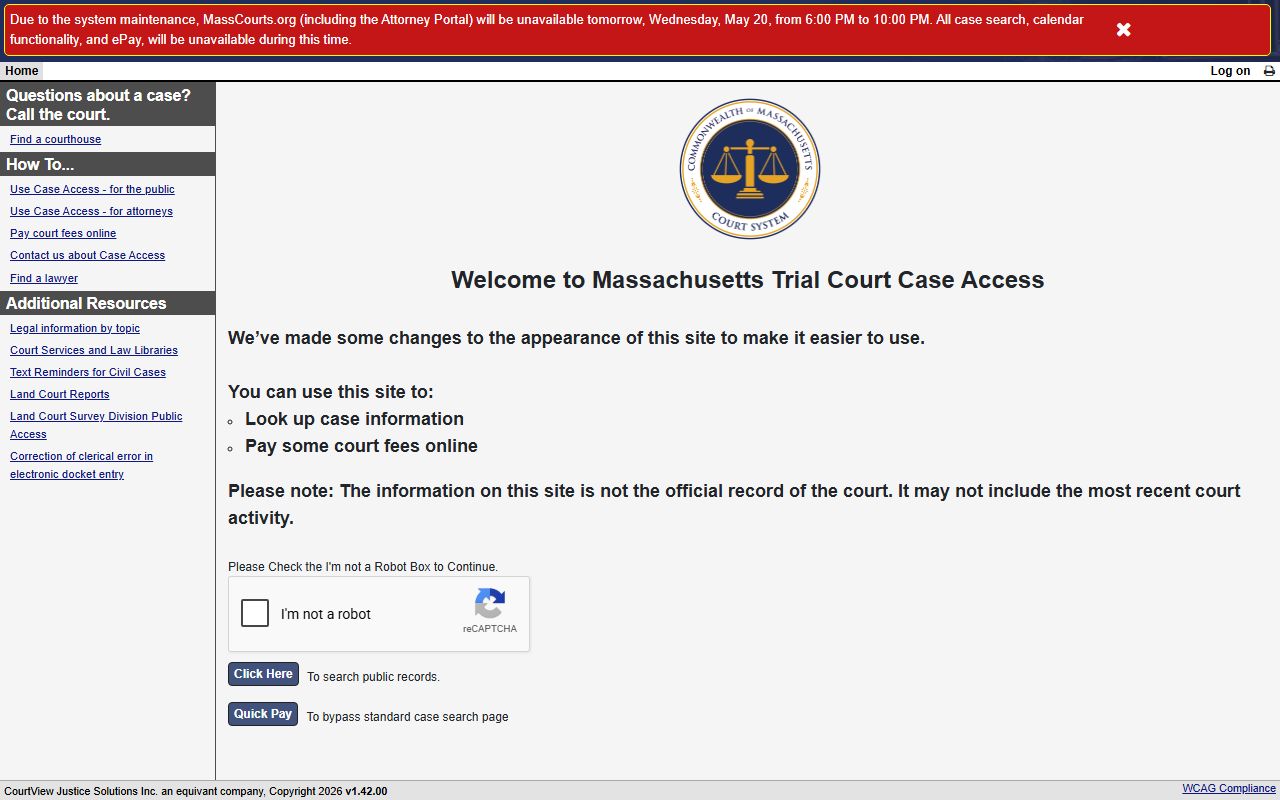
That screen is where most Hampden County court record searches begin before you ever call a clerk.
The Hampden County Judicial System
Hampden County court records live inside the Massachusetts Trial Court, which has seven departments. The Trial Court is run statewide, not by the county. That is why there is no single "Hampden County clerk" who holds every file. Each department keeps its own dockets and answers its own copy requests.
The Executive Office of the Trial Court oversees administration, public access, and court services across the state, and its overview page explains how the departments fit together at the Executive Office of the Trial Court.
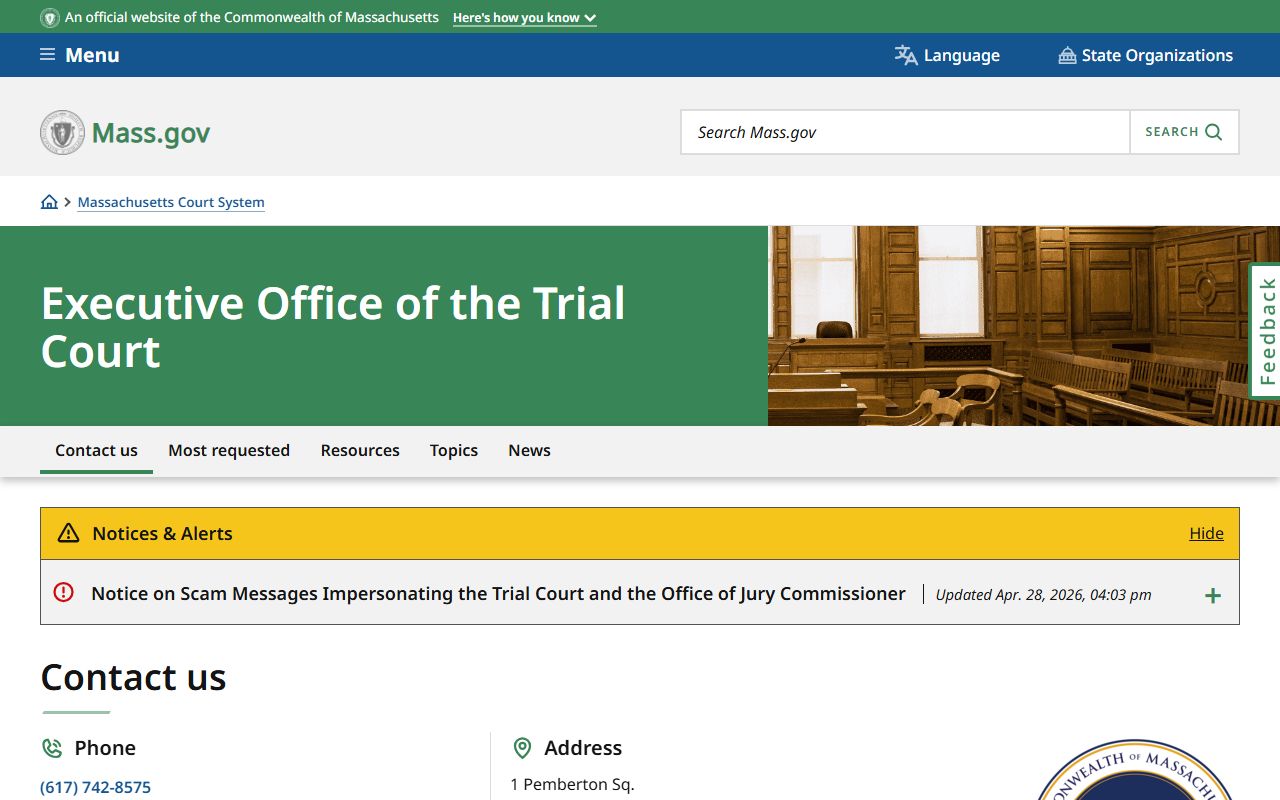
That office sets the access rules that shape what you can and cannot see online for a Hampden County case.
Case flow: District Court or Superior Court (trial) › Massachusetts Appeals Court › Supreme Judicial Court
| Court | Role | Case Types |
|---|---|---|
| Supreme Judicial Court | Highest court; statewide court rules | Final appeals, constitutional and statutory questions |
| Massachusetts Appeals Court | Intermediate appeals | Most civil and criminal appeals from the Trial Court |
| Superior Court | Major trial court | Serious felonies, high-value civil, equity, malpractice tribunals |
| District Court | Local trial court | Misdemeanors, some felonies, small claims, traffic, restraining orders |
| Probate and Family Court | Family and estates | Divorce, custody, support, guardianship, wills, name change |
| Housing Court | Housing matters | Evictions, code enforcement, landlord-tenant disputes |
| Land Court | Statewide property court | Registered land, tax liens, zoning appeals, partition |
The statewide court system page links every department, the Appeals Court, and the Supreme Judicial Court for context on the Massachusetts court system site.
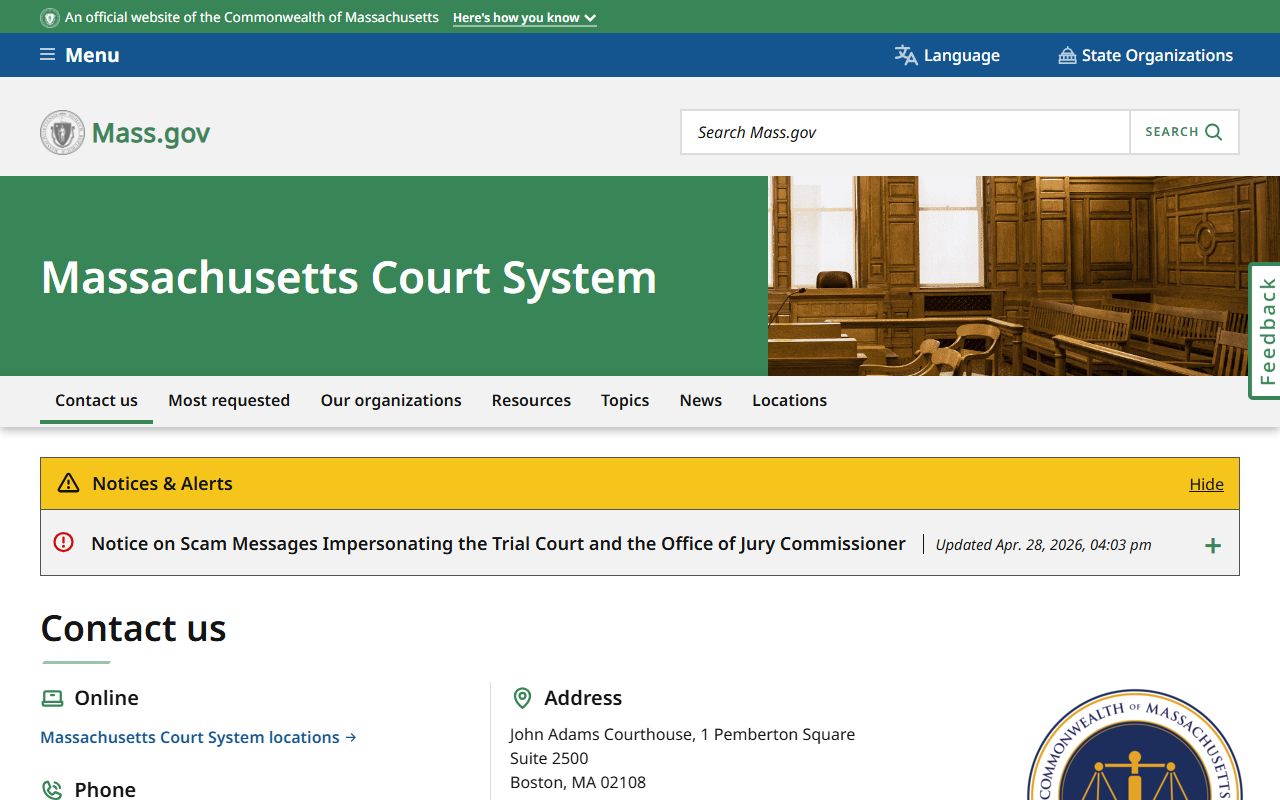
Use it to confirm which department fits your Hampden County matter before you search.
Hampden County Courthouses
The main courthouse is the Roderick L. Ireland Courthouse at 50 State Street in downtown Springfield. It holds Hampden County Superior Court, the Hampden Probate and Family Court, Springfield District Court, and the Western Housing Court Springfield Session. Other District Court divisions sit in Chicopee, Holyoke, Westfield, and Palmer. The right counter depends on the case type and where the matter started.
Palmer District Court, at 235 Sykes Street, serves the eastern part of the county. Each building runs security screening at the door, so plan extra time and bring a photo ID.
Types of Court Records Available in Hampden County
Court records in Hampden County split by department. Superior Court keeps the most serious criminal and civil files. District Court keeps a much larger volume of smaller cases. Probate and Family Court keeps divorce and estate files. Housing Court keeps eviction and code cases. Knowing the category points you to the correct search and the correct clerk.
Most records fall into a handful of groups. Each one is produced by a different mix of departments.
- Criminal records - felony and misdemeanor cases, from arraignment through disposition and sentence.
- Civil records - lawsuits, contract and injury claims, small claims, and debt matters.
- Family and divorce records - divorce, custody, support, paternity, and name change.
- Probate records - estates, wills, guardianship, and conservatorship.
- Traffic court records - civil motor vehicle citations and criminal driving charges.
- Housing records - evictions, conditions cases, and code enforcement.
Juvenile cases also exist, but those files are restricted by law and do not show up in an ordinary public search.
What Hampden County Court Records Show
A public case record gives you the basic shape of a matter. It names the parties, lists the events, and shows how the case ended if it is closed. It does not always include every scanned document. Many filings still require a clerk request or an in-person visit. The fields below appear on a typical public case detail in MassCourts.
| Field | What It Shows |
|---|---|
| Case Number | The docket number assigned by the court department. |
| Court | The department and division, such as Hampden Superior Court. |
| Filing Date | When the complaint, petition, or citation was entered. |
| Parties | Plaintiff and defendant, or Commonwealth and defendant in a criminal case. |
| Docket Entries | The dated list of filings, motions, hearings, and orders. |
| Disposition | The outcome of the case or a single charge. |
Sensitive items stay hidden. Social Security numbers, financial account numbers, minor names, protected addresses, and medical details are redacted or sealed. For a full read of every field, see the Hampden County court records page.
Public Access Laws for Hampden County Court Records
Massachusetts treats agency records and court records differently. The public-records law covers police, sheriff, and town records. Court files are governed by court rules and the clerk or register, not by a public-records request. Criminal history is a third path called CORI, which has its own controls. These statutes set the framework for what is open and what is closed.
Key Statutes:
M.G.L. c. 66, § 10 - the core public-records request statute for state and town agencies.
M.G.L. c. 4, § 7 - defines public records and lists the exemptions.
M.G.L. c. 6, § 172 - controls who may receive CORI criminal-history reports.
M.G.L. c. 276, § 100A - allows sealing of certain convictions after waiting periods.
M.G.L. c. 119, § 60A - keeps most juvenile delinquency records confidential.
A court docket search is not the same as a CORI report. Employers, landlords, and licensing bodies must follow CORI rules. More detail sits on the Hampden County public records page.
Records That Are Restricted or Confidential
Not every court record is open. Massachusetts law and court rules close off whole categories. Juvenile delinquency, care and protection, and youthful-offender files are limited to parties, lawyers, agencies, and people with a court order. Adoption records are confidential. Mental-health and civil-commitment records can be impounded even when a court event exists. Abuse-prevention orders protect addresses and safety details.
Sealed and expunged records work differently. A sealed record does not show up in an ordinary search and is treated separately for jobs and licensing. An expunged record is removed under statute, which is a higher bar than sealing. To view a sealed file, a person usually must be a party or get court authorization, and the request goes through the clerk and the judge, not through a public-records form.
Specialty Courts in Hampden County
Massachusetts runs problem-solving sessions inside its Trial Court departments rather than as separate county courts. Hampden County residents may see a drug or recovery court, a veterans treatment session, or a mental-health session. Holyoke District Court, for example, includes a Veterans' Treatment Court. These sessions pair supervision with treatment for eligible people whose cases connect to substance use, service-related trauma, or mental illness.
Newer programs keep arriving. In December 2023 the Trial Court opened a Family Treatment Court session in Springfield at the Hampden County Juvenile Court, backed by a federal grant. Eligibility is never automatic. A clerk, probation officer, defense lawyer, or the district attorney can confirm whether a current case qualifies and how a referral works.
Hampden County Sheriff and Jail
The Hampden County Sheriff's Office, led by Sheriff Nick Cocchi, runs the county's correctional and reentry facilities. The main site is the Hampden County Correctional Center in Ludlow, with a regional women's center in Chicopee and recovery and reentry sites in Springfield. The Sheriff handles people held before trial and people serving county sentences, which is different from the state prison system.
One thing to know up front: the Sheriff's Office does not appear to publish a public online jail roster. Custody must be checked by other means. For the full picture, see the Hampden County inmate records page, and check the warrant records page if you think a court has issued a warrant.
Marriage, Divorce, and Probate Records
Marriage records in Massachusetts are municipal. Couples file a marriage intention with a city or town clerk, not a county clerk, so a Springfield couple works with the Springfield City Clerk. Certified copies come from that clerk or from the state vital records office. Divorce and estate files belong to the Hampden Probate and Family Court. See the marriage and divorce records page and the probate records page for the steps and forms.
Probate paperwork uses terms that confuse many searchers. A few common ones are defined below.
- Testator
- The person who made a will.
- Executor
- The person named to carry out a will.
- Conservator
- A person appointed to manage another adult's money or property.
Federal Court Records for Hampden County
Some Hampden County matters are federal, not state. Federal crimes, federal-question lawsuits, and large diversity cases go to the U.S. District Court for the District of Massachusetts, which holds court in Springfield. Federal dockets are not in MassCourts. They live in the federal PACER system, with appeals to the First Circuit and bankruptcy in a separate federal court.
The official federal docket and document system is PACER, and the district's own site is the U.S. District Court for the District of Massachusetts. PACER charges per page and needs registration. For free opinion research, CourtListener is a useful alternative, though it is not the official record keeper.
Fees for Hampden County Records and Copies
Court fees in Massachusetts are set by Trial Court schedules and by each clerk, so there is no single countywide price list for certified copies. Driving records carry fixed state fees, and small claims has a clear dollar limit. The table shows the figures that are published, with the rest set at the office that holds the file.
| Item | Amount |
|---|---|
| Unattested driving record (online) | $8 |
| True-and-attested driving record | $20 |
| Certified driving history | $20 |
| Small claims general limit | $7,000 |
| Certified court copies | Set by each clerk; ask the office |
Driving-record fees come from the Registry of Motor Vehicles, not the court. Ask the relevant clerk or register for the current certified-copy fee before you mail a request or visit a counter.
How to Interpret Hampden County Court Records
Docket language can be hard to read. A charge is not a conviction. A disposition is the outcome, which may be guilty, not guilty, dismissed, or continued without a finding. A default means someone missed a required step, which can trigger a warrant or a capias. Knowing a few terms makes a docket far easier to follow.
- Plaintiff
- The party who starts a civil case.
- Defendant
- The party sued or charged.
- Docket
- The dated list of everything filed and ordered in a case.
- Disposition
- How a case or a charge ended.
- Capias
- A court order to bring a person to court, often after a missed date.
- Impounded
- A record kept from public view by rule or order.
The Hampden County court dockets page breaks down each event type in more depth.
Accuracy and Record Limitations
Online court data can lag real life. A clerk reviews entries before they post, so a hearing or filing may not appear the same day. Older, archived, transferred, or sealed cases may not display in full. A name search can miss a case filed under a different spelling or a business name.
Note: Always confirm a case detail with the clerk or register that holds the file before you rely on an online record for any legal or financial decision.
History of Hampden County Courts
Hampden County was formed in 1812 from part of Hampshire County, with Springfield as the county seat. Springfield grew into the legal and commercial hub of western Massachusetts, and its courts grew with it. The downtown courthouse is named for Roderick L. Ireland, who became the first Black Chief Justice of the Massachusetts Supreme Judicial Court.
Court geography still tracks the county's cities. Springfield holds the main Superior, Probate, District, and Housing functions, while Chicopee, Holyoke, Palmer, and Westfield have their own District Courts. The move to MassCourts and eFiling shifted research away from paper index books, though clerks and registers still handle certified copies, older files, and restricted-record questions.
Self-Help and Legal Aid in Hampden County
People without a lawyer have real options in Hampden County. Trial Court service centers help with forms and procedure. Community Legal Aid handles civil matters in western Massachusetts. For criminal cases, the Committee for Public Counsel Services provides counsel to people who qualify, usually requested at arraignment.
Other paths help too. The Hampden County Bar Association offers lawyer referrals, and the Massachusetts Legal Resource Finder triages civil questions online. Court staff can explain process and hand out forms, but they cannot give legal advice or act as your lawyer.
Frequently Asked Questions
How do I search Hampden County court records online?
Use the MassCourts eAccess portal. Pick the court department and division, such as Hampden Superior Court or Springfield District Court, then search by name, case number, or citation. Sealed, impounded, juvenile, and adoption matters may not appear. If a public case will not load, try the exact docket number or call the clerk.
Is there a Hampden County clerk of court?
No single clerk controls every record. Each Trial Court department has its own clerk or register. Superior Court, District Court, Probate and Family Court, and Housing Court each keep their own files. Land records go to the Registry of Deeds, and marriage records to city or town clerks. See the clerk of court page for who holds what.
Where is the main courthouse?
The Roderick L. Ireland Courthouse sits at 50 State Street in Springfield. It holds Hampden Superior Court, the Probate and Family Court, Springfield District Court, and the Western Housing Court Springfield Session. District Courts in Chicopee, Holyoke, Palmer, and Westfield handle local matters for those areas.
Can I get criminal records from MassCourts?
MassCourts shows public criminal dockets, not a full CORI report. A docket may list charges, events, bail, and disposition when public. CORI is the official criminal-history product and is governed by separate law. The arrest records page explains the difference.
How do I find an inmate in the Hampden County jail?
No official public jail roster was found on the Sheriff's Office site. Use the Sheriff's Office contacts, check VINELink for custody notifications, and search MassCourts for the related criminal case. Avoid unofficial mugshot or people-search sites. The inmate records page lists the working channels.
What court handles evictions?
Most Hampden County evictions and housing-condition cases go to the Western Housing Court, Springfield Session. Some housing matters may also appear in District Court depending on the filing. Search MassCourts under Housing Court, or see the Housing Court page.
More answers sit on the Hampden County Court Records FAQ page.