
Hampden County Jail Roster Overview
The Hampden County Sheriff's Office, led by Sheriff Nick Cocchi, runs the county's correctional and reentry facilities. Its main site lists facilities, visiting, mail, phone, and deposit information. What it does not appear to offer is a searchable public roster of current inmates, so you cannot simply type a name into a county jail database.
A county jail roster, even where one exists, would not show everyone. It would not cover people in state prison custody under the Massachusetts Department of Correction, people in federal custody, or people held by another agency. Hampden County holds people before trial and people serving county sentences, which is a different group from state prisoners.
The Sheriff's Office publishes facility, program, and contact details on its official site, the Hampden County Sheriff's Office homepage.
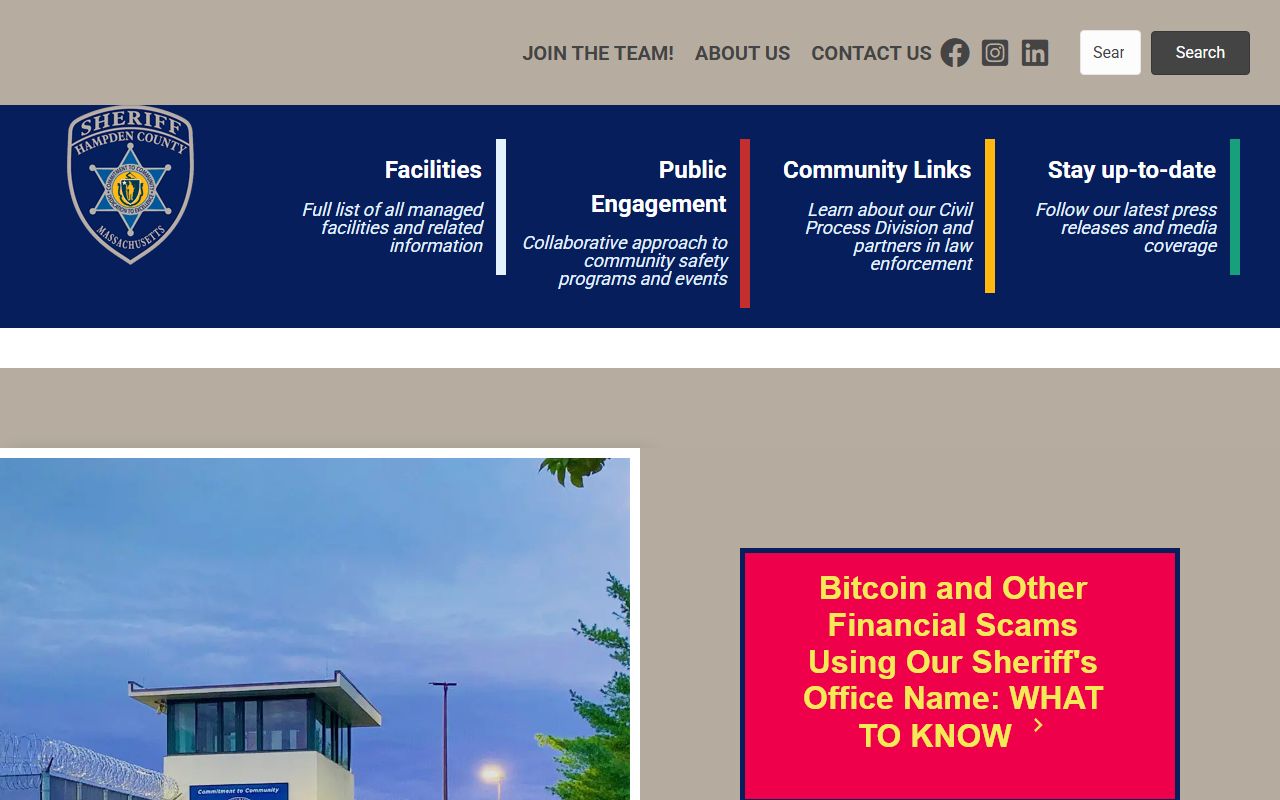
That site is the anchor for facility and contact information, even though it does not host a name-search roster. For a missing roster, the lawful fallback is to call the facility directly or to send a narrow public-records request to the Records Access Officer for jail policy or aggregate population records.
How to Verify Custody in Hampden County
Without a public roster, you confirm custody through a mix of official channels. Start with the tool that fits what you know, then cross-check.
- Search VINELink for custody status and to register for notifications, where the agency participates.
- Search MassCourts for the related criminal case to see arraignment, bail, and status.
- Call the Sheriff's facility directly to confirm whether a person is held there.
- Check the state DOC locator for prison custody, or the federal BOP locator for federal custody.
Avoid unofficial mugshot or people-search sites; they are often wrong and may charge fees for removal.
Timing matters right after an arrest. A person booked late in the day may not appear in any system until processing finishes, and a court entry may wait for arraignment. If a first search turns up nothing, try again later and call the facility before assuming the person is not held.
Custody Search Tools and Fields
Because no single county database exists, the practical search field set comes from VINELink, the statewide notification system. It accepts the fields below, though coverage depends on the participating agency.
| Field Label | Type | Required | Notes |
|---|---|---|---|
| State | Dropdown | Yes | Select Massachusetts. |
| Last Name | Text | Conditional | Search by the person's name. |
| First Name | Text | Optional | Narrows the search. |
| ID Number | Text | Optional | Agency or custody ID if known. |
| Facility / Agency | Filter | Optional | Coverage depends on the participating agency. |
What an Inmate Profile Shows
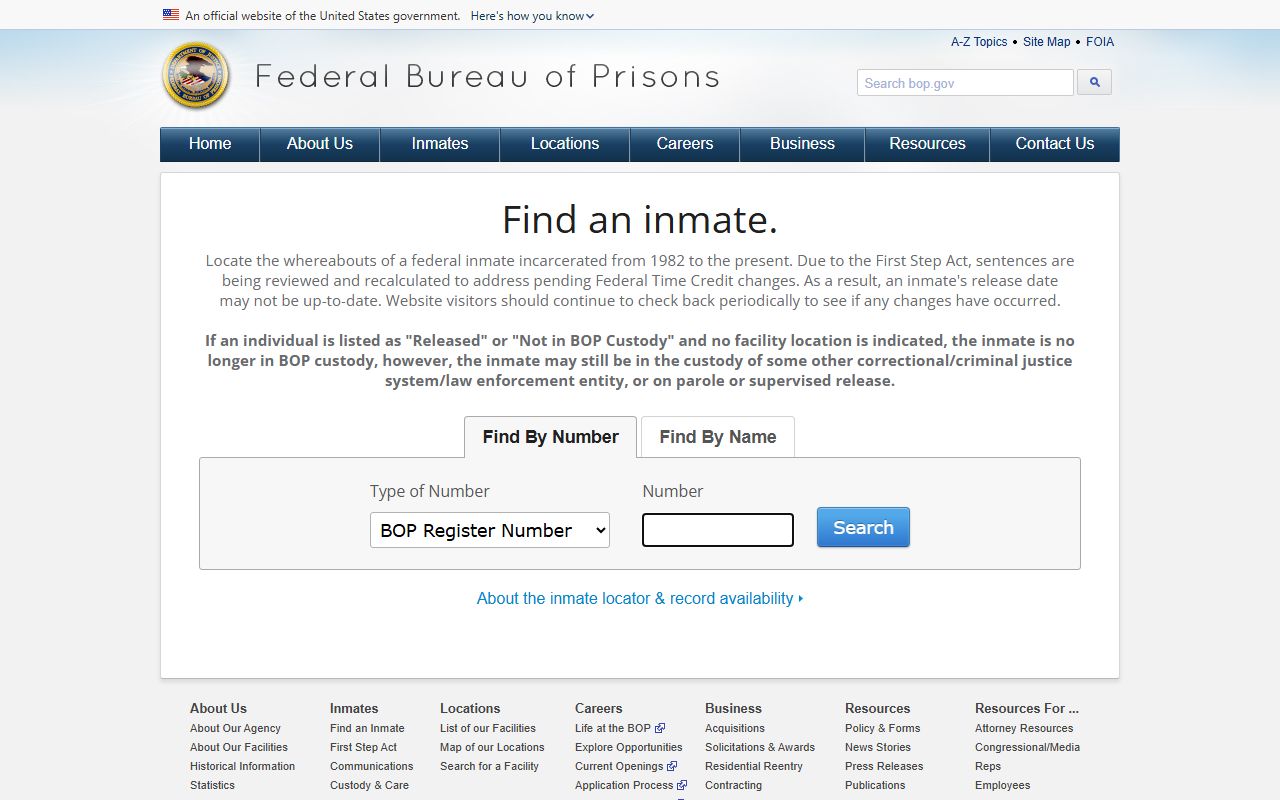
No official Hampden County jail profile could be inspected, since there is no public roster, so this page does not invent pod, bond, or mugshot fields. For federal custody, the Bureau of Prisons locator does return a profile, and its fields give a useful model of what an official record shows.
| Field (Federal BOP example) | What It Shows |
|---|---|
| Register Number | The federal inmate identifier. |
| Name | The inmate's name as recorded. |
| Age / Sex / Race | Basic identifying details. |
| Release Date | The actual or projected release date. |
| Location | The current facility, or a released status. |
For county custody, that level of detail is not posted publicly, so the Sheriff's facility or VINELink is the place to confirm a person's status.
Hampden County Jail Facilities
The Sheriff operates several sites with different roles. The main correctional center is in Ludlow, the women's regional center is in Chicopee, and treatment and recovery sites sit in Ludlow and Springfield. The cards below list the main facilities and their published phone numbers.
Hampden County Correctional Center
627 Randall Road
Ludlow, MA 01056
(413) 858-0000
Main county correctional center
W. Mass. Regional Women's Correctional Center
701 Center Street
Chicopee, MA 01013
(413) 730-6800
Women's regional facility
W. Mass. Recovery and Wellness Center
155 Mill Street
Springfield, MA 01108
(413) 886-0110
Treatment and recovery
Stonybrook Stabilization & Treatment Center
627 Randall Road
Ludlow, MA 01056
(413) 858-0701
Civil commitment and treatment
Reentry and community services run through the All-Inclusive Support Services office at 736 State Street in Springfield. The agency's facility and operations details appear in its public information.
Always confirm the right facility before you visit, mail, or deposit funds, since a person may move between sites.
Booking Process in Hampden County
After an arrest, a person may be taken to a police department, a court, or a sheriff facility, depending on timing and bail. Booking usually includes identity checks, a warrant check, a property inventory, medical and mental-health screening, fingerprints, a photo, and classification before housing or release.
Arraignment timing depends on the arrest time, court hours, and the bail decision. Massachusetts uses bail commissioners and court bail decisions, so a person may be released on personal recognizance, on cash bail, on conditions, or held after a dangerousness hearing. Posting bail takes current instructions from the court, police, or facility, since the responsible agency can change by stage.
When you call about a person in custody, have the basics ready. The full legal name, date of birth, and any case or booking number speed up the answer. Ask which facility holds the person, what the visiting and deposit rules are, and whether the person has already been moved, since classification can change where someone is housed.
Visitation Rules
The Sheriff publishes visitor information online, and rules can change by housing unit, security level, holiday, or emergency. Read the current visiting page before each visit. The table summarizes the topics to check, rather than fixed hours, which vary.
| Topic | What to Confirm |
|---|---|
| Scheduling | Use the current Sheriff visiting page, not old third-party schedules. |
| Identification | A government photo ID is typically required. |
| Children | May need guardian permission and supervision. |
| Dress code | Clothing rules are enforced at entry. |
| Denial reasons | Late arrival, no ID, contraband, or prior suspension. |
| Attorney visits | Run under a separate professional-visit procedure. |
Federal and State Custody Searches
If a person is not in county custody, two official locators help. The federal Bureau of Prisons locator covers federal inmates by name or register number.
You can search federal custody at the Federal Bureau of Prisons inmate locator.
For notifications about a county or state custody change, VINELink lets you register by phone, email, or app where the agency participates.
Set up custody alerts through VINELink Massachusetts, the statewide notification portal.
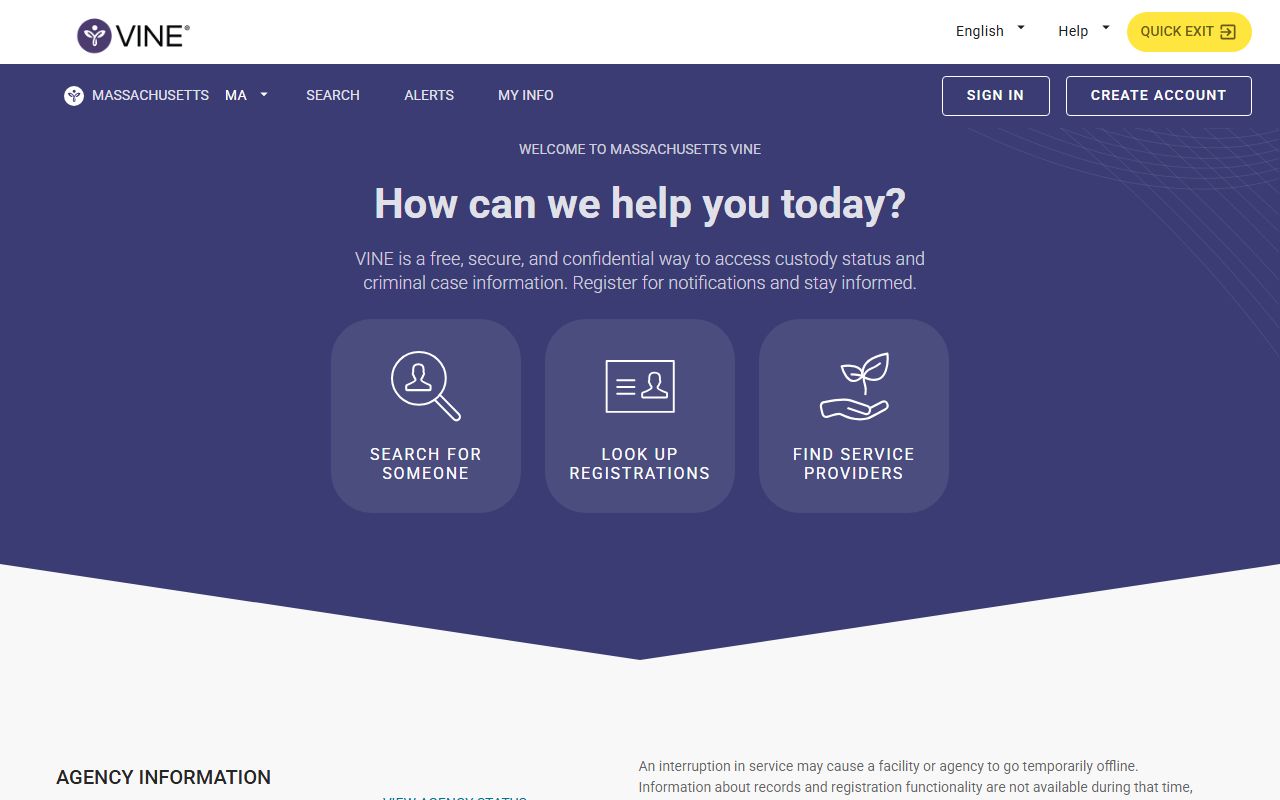
Coverage depends on the agency feed, so confirm important details with the facility directly.
Interpreting Custody Status
Custody words are slippery, and a quick search can mislead. The same person can be in police lockup, county jail, state prison, federal detention, a hospital hold, or a treatment commitment, and each sits in a different system. Reading a result correctly is as important as running the search.
- In custody can mean a county jail, a state prison, federal detention, or a treatment hold.
- Released can mean bail posted, a sentence completed, or release to probation or parole.
- Transferred can look like a release in one system while custody continues in another.
- No result can mean a wrong spelling, a sealed record, a nonparticipating agency, or an actual release.
Because of this, treat any single tool as a starting point. Confirm an important conclusion with the facility that would actually hold the person.
Public Record Limits on Jail Information
County jail custody information is not the same as state prison information, and it is not as open as a court docket. The Massachusetts DOC locator covers sentenced state prisoners, not everyone held pretrial in Hampden County. VINELink may provide notifications only where the agency participates. CORI and court records are governed by separate laws. For aggregate jail records, such as policies or population reports, a public-records request to the Sheriff is the lawful route, covered on the public records page.
How to Contact a Hampden County Inmate
Mail, phone, and deposits all follow Sheriff rules. Mail needs the inmate's full name and the facility-specific address, and common banned items include cash, checks, stickers, and explicit content. Calls are usually prepaid or account-based through a contracted provider, and calls other than properly arranged attorney calls are typically recorded. Families should not discuss pending charges on a recorded line.
Commissary and Inmate Funds
Money deposits and commissary access follow the Sheriff's published instructions. Deposit systems may allow online, kiosk, mail, or phone options, and any service fees should match the official vendor or Sheriff page. Verify the inmate's identity and current facility before depositing money, since deposits may be nonrefundable. Commissary access also depends on facility rules, classification, the account balance, disciplinary status, and the commissary schedule, so a deposit does not always reach the inmate the same day it is sent.