
About the Massachusetts Land Court
Land Court is one of seven Massachusetts Trial Court departments and has statewide jurisdiction over specific real-property matters. It is the court for registered land, certain tax-lien proceedings, partition cases, foreclosure-related actions, and many zoning and permit appeals. Land Court does not handle every real-estate case, but for the categories it covers, it is the only forum.
The department publishes a statewide overview at the Massachusetts Land Court page.
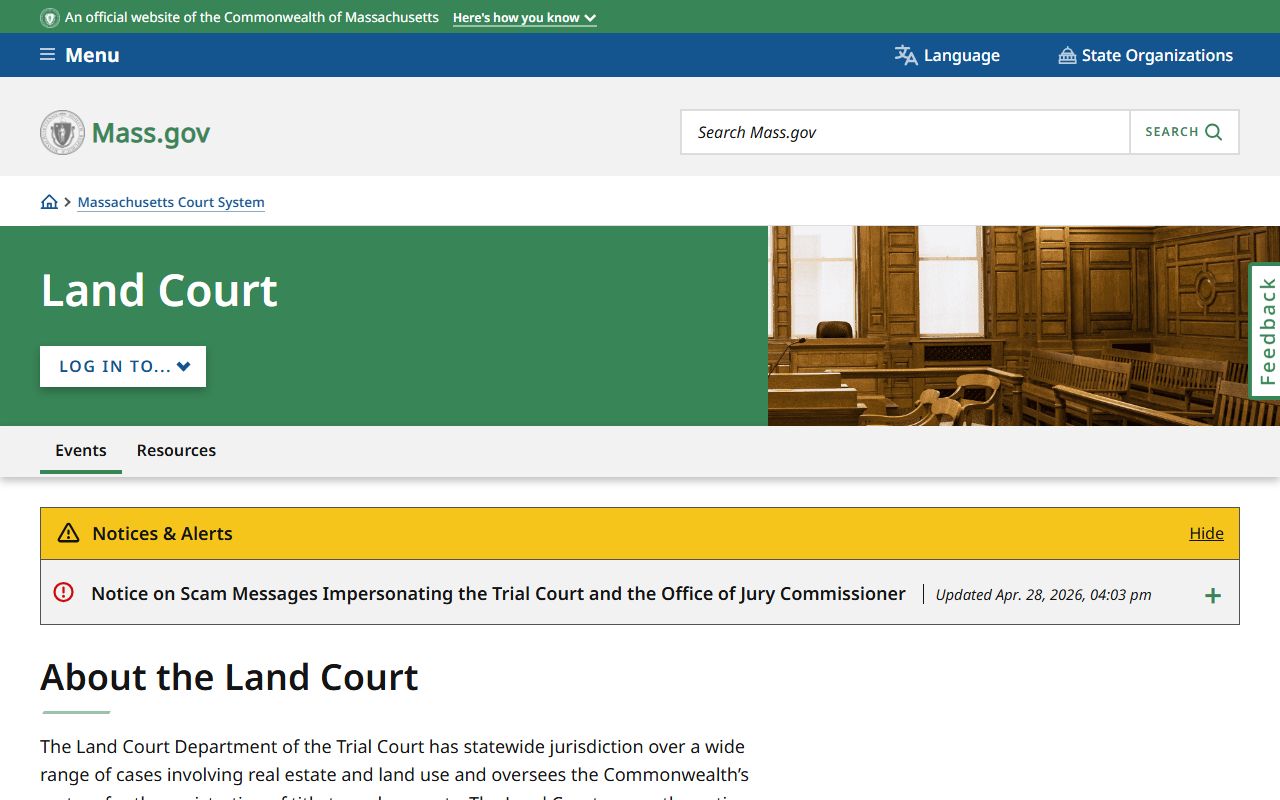
That page describes jurisdiction, locations, and the kinds of cases the court hears.
Cases the Land Court Hears
Land Court's caseload is narrow but important. Its rulings affect titles, tax sales, and the use of land across Hampden County. Common categories include the following.
- Registered-land proceedings, including original registration and later documents.
- Tax-lien foreclosure cases brought by municipalities.
- Mortgage foreclosure servicemembers cases and related proceedings.
- Partition cases dividing jointly owned property.
- Zoning and special-permit appeals from local boards.
- Quiet-title actions to fix defects in a chain of title.
Land Court vs Registry of Deeds
These two offices get mixed up often. The Registry of Deeds is a recording office. It records and indexes deeds, mortgages, discharges, liens, plans, and registered-land documents. It does not decide disputes. The Land Court is a court. It hears cases and issues judgments. Both interact with the same properties, but they do very different jobs.
| Topic | Land Court | Registry of Deeds |
|---|---|---|
| Role | Court that hears cases | Recording office for documents |
| Main work | Registered land, tax title, zoning, partition | Deeds, mortgages, discharges, liens, plans |
| Output | Judgments and orders | Recorded instruments and an index |
| Access | MassCourts; clerk for copies | Online land-records system; registry for copies |
How to Search Land Court Records
Land Court dockets are searched through MassCourts, the statewide case system. The case may be filed in Boston, but it can involve property anywhere in the state, including Hampden County.
- Open the MassCourts eAccess portal.
- Choose Land Court as the department.
- Search by party name, case number, or address-related parties.
- Open the case and review docket events and orders.
- Contact the Land Court Recorder for documents that are not online.
Searching Hampden County Land Records
For deeds, mortgages, and other recorded instruments, the search system is run by the registries of deeds, not the Land Court. Hampden County recorded-land and registered-land documents are indexed through the Hampden County Registry of Deeds and the statewide MassLandRecords system. The right tool depends on the kind of document.
- Recorded land uses an ordinary book and page system.
- Registered land uses a separate certificate-based system.
- Court cases about that property may live in the Land Court docket.
What Land Records Show
A registry document and a Land Court case show different things. The registry index gives the document number, book and page, recorded date, document type, grantor and grantee, and any related references. A Land Court docket gives parties, claims, motions, orders, and a final judgment. Used together, they answer most questions about title, encumbrances, and the legal effect of a transaction.
Search Tips for Hampden County Property
A few simple habits make land searches more reliable. They reduce missed documents and missed cases.
- Search both grantor and grantee names when tracing a chain of title.
- Try maiden names, prior business names, and trust names.
- Use book and page or document numbers when available, since exact searches avoid index problems.
- Check for mortgage discharges, assignments, homesteads, municipal liens, and tax takings.
- Remember that registered land uses certificate references, not book and page.
How Land Records Connect to Other Court Cases
Real property often shows up in other court cases too. A civil judgment from Superior or District Court may later record at the registry as an execution or lien. A divorce judgment may require a deed transfer that ends up at the registry. A probate decree may authorize a personal representative to sell estate property. A tax-title or foreclosure matter may produce both court and registry filings. The full picture often requires both court dockets and registry indexes.
Tax Title and Foreclosure Cases
Tax-title cases are an important share of Land Court's docket. When a Massachusetts municipality forecloses on a tax lien, the case is filed in Land Court. The court issues judgments that affect title and can transfer property to the municipality or other parties. These cases can be slow because they require notice to every interested party.
Mortgage foreclosure also touches Land Court through Servicemembers Civil Relief Act proceedings, which confirm whether the borrower is on active military duty before a foreclosure can proceed. Those cases are filed by lenders before a sale and run statewide.
Registered Land vs Recorded Land in Hampden County
Massachusetts uses two parallel land-record systems, and they are not interchangeable. Recorded land is the older system, using book and page references for documents that build a chain of title. Registered land is a separate system created by court order, using certificates of title that are kept current by the registry's registered-land section. The Land Court oversees the registered-land side.
A title search in Hampden County may touch both systems, depending on the property. A recorded-land deed and a registered-land certificate do not look the same, and a search that only uses one tool can miss documents. When in doubt, ask the registry staff which system the property uses.
Zoning and Special Permit Appeals
Land Court hears appeals from local zoning boards and planning boards on many decisions. A neighbor who disagrees with a variance, a developer denied a special permit, or a town defending its zoning decision can all end up there. These cases run alongside Superior Court appeals, since some zoning claims can be filed in either forum.
Filing deadlines are short. A person who wants to appeal a local zoning decision should consult a lawyer right away, because the deadline can run from the date the decision is filed with the clerk. Missing the deadline usually ends the appeal, even when the underlying decision is questionable. Local boards in Hampden County cities like Springfield, Chicopee, Holyoke, and Westfield each have their own posting practices, so confirming the filing date with the city or town clerk is a smart first step. A short consult with a land-use lawyer can also reveal whether the case belongs in Land Court or Superior Court before any complaint is filed. Picking the wrong forum can waste filing fees and reset the clock.